Humans
The Reincarnated Demon King's Host Just Wants to Live in Peace, But the Hero Won't Leave Him AloneHumans are the principal mortal population of Algeya, but their importance is not limited to demographic presence. Their kingdoms provide the political framework for magic testing, Hero training, military defense, and legal judgment, while their shared vulnerability to Demons has forced them into cooperation with other peoples. At the same time, human institutions repeatedly turn human bodies into instruments of security: gifted children are claimed for service, healers are assigned to Heroes, and suspected Demon hosts can be restrained and placed outside ordinary protection. Humans therefore embody both the possibility of a united society and the danger of a society that preserves itself through coercion.
Kingdoms, Borders, and Shared Defense
Humans are one of the mortal races with a kingdom of their own, and the human-governed kingdom of Rizaah contains the capital where royal government, councils, and military education are concentrated. Algeya is divided into kingdoms ruled by the different mortal races, with the exception of the more nomadic Orcs. People can live where they choose and cross borders with relative ease; the division exists to prevent one race from suppressing another and to keep each kingdom’s resources from being stretched too thin. This arrangement is presented as a political compromise rather than natural separation.
The apparent peace among the peoples is also inseparable from the Demon threat. Humans, Elves, Dwarves, and the other mortal races united generations earlier because Demons were a common enemy, formed joint laws, and learned to cooperate for collective survival. The alliance is therefore both genuinely connective and historically dependent on danger. Even after Malthios was defeated, remnants of his army remained across the land under the command of Demon Lords, leaving the Hero’s party responsible for protecting common folk. Human security is never merely domestic; it is organized around the expectation of renewed supernatural war.
The capital’s palace makes this fusion of sovereignty and defense visible. One half houses the King and his family and hosts councils and balls; the other trains magic users and knights who will serve the royals or join the Hero’s party. The building thus places ceremony, administration, and militarized education within one connected complex. Human rule is shown not as a purely civilian order but as a structure whose culture and survival depend upon the production of armed and magically specialized servants.
Magic, Childhood, and Institutional Claims
Human society treats magical assessment as an ordinary route toward advancement, including for common families. When Theo was eight, his parents brought him from a small village to the capital so that officials could test him. They hoped that sponsorship to an academy or mentorship in a lucrative craft might provide him with a better life, even though they were not convinced that he possessed magic. The test therefore appears charitable and meritocratic on its surface, but it also exposes children to public valuation and institutional ownership.
The examination took place in a great hall before the King and his council, while representatives of different races and magical disciplines waited to bid for talented children. A large orb detected a person’s magic through touch and remained dark if no magic was present. Theo feared that it would reveal Malthios’s power inside him and lead to his immediate execution, but it instead produced his own deep emerald-green healing magic, so brilliant that it temporarily blinded everyone present. His gift did not return him to his family or permit him to choose his future. The court mage declared that someone with such an ability belonged in the Hero’s party and ordered that he be taught by Algeya’s greatest healer before entering training with the next Hero.
The human system consequently converts exceptional ability into obligation at an early age. At sixteen, the legal age of adulthood, Theo was told that guards would collect him and take him back to the capital to meet the new young Hero and the other companions. They were expected to train together until the Hero came of age, after which responsibility for purging the remaining Demons and protecting common people would pass to them. Theo escaped instead, traveling with Malthios for two years, taking odd jobs and moving north in search of a village beyond the reach of both Demons and Heroes. His flight demonstrates that human institutions can define a gifted child’s purpose before he has the power to refuse it.
Humans in War and Moral Contradiction
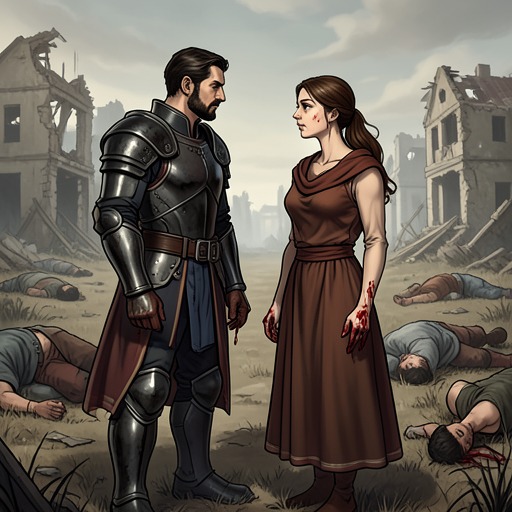
The war between Humans and Demons is not presented as a simple opposition between civilized life and monstrous violence. A burned village becomes a scene of human and animal suffering, with houses reduced to blackened skeletons, smoke filling the air, and those attempting to flee killed by Demon blades. Yet the narration pauses over the observation that Humans and Demons, despite their differences, bleed the same color. The image does not erase the brutality of the attack, but it undermines the fantasy that the opposing peoples are wholly unrelated kinds of being.
Malthios’s reaction makes the contradiction sharper. He regards mortals as a plague that harms the world and one another, and he feels little satisfaction even while watching the carnage. His contempt is inseparable from a warped meditation on mortality: he questions the value of lives that end quickly and asks what purpose existence has if life is not valued. The scene reveals how Demon ideology can turn human vulnerability into a justification for annihilation, while the shared blood of the victims exposes the biological and ethical continuity that ideology denies.
Humans also participate in violence through the language of duty. Theo condemns Eliza for turning a child into a weapon, while Eliza answers that he cannot understand duty because he abandoned his own. Their conflict sets human responsibility against human freedom. The Heroic order calls sacrifice necessary for the protection of common folk, but the same order can treat a child’s body, magical gift, or inherited connection to danger as public property. Human morality is therefore divided between care for vulnerable people and the willingness to instrumentalize them in the name of everyone else.
Family, Community, and Social Belonging
Human relationships are not defined solely by blood or official status. Dale and Imani, unable to have children, recognize Theo’s need when he arrives at their tavern and begin caring for him almost instinctively. Their welcome gives him forms of parental affection he had never known: Imani gives him his first hug, and Dale makes a cake for his eighteenth birthday, the first birthday he celebrates. Their care shows human community operating outside the institutions that previously claimed him, through repeated acts of food, shelter, tenderness, and recognition.
This practical form of kinship is echoed in Leafel, where Theo builds a home and a healer’s shop. The shop is rustic and partly run-down, with potions and herbs lining its walls, but it is home because he made it himself. Human belonging in the village is likewise established through daily presence rather than legal assignment. The funeral of Glefald, an Elf, demonstrates that a human community can honor another race’s custom: villagers bury him in the earth and plant a tree over his body, following the tradition he desired, while adventurers, Micah, and even the village cat attend. Such scenes place human identity within a wider network of chosen family and mutual obligation.
The contrast with formal authority remains stark. At the capital, Theo encounters guards, royal officials, court mages, and magical mirrors that allow distant rulers to participate in council without traveling through portals. In Leafel, the significant spaces are a shop, a garden, a tavern, a grave, and the roads connecting neighbors. Human political power makes people visible to the state; community makes them visible to one another.
Law, Surveillance, and the Limits of Protection
When Theo’s identity as the host of the reincarnated Demon King is exposed, human authority treats him as an exceptional danger. He is placed in magic-dampening handcuffs on the orders of the court mage and Hero Eliza, with the justification that he cannot simply be allowed to run free. The restraint shows how quickly the language of protection becomes confinement when a human body is associated with an enemy power. Theo remains a healer and a person known to the community, but the state’s security logic reduces him to a potential vessel.
His trial intensifies this transformation. In the throne room, members of the court and representatives from other meeting rooms appear through mirror spells, while a large mirror broadcasts the proceedings to towns, villages, and cities throughout Algeya. Theo is pushed to his knees before the throne as the court announces that he is the host of Malthios. The technology of the room turns judgment into public spectacle: the human realm does not merely decide what to do with him, but displays the decision across the country.
Yet the legal order also contains a limit on collective vengeance. King Alexis states that the decision belongs solely to Hero Luca, even when others object that Luca is biased because he and Theo were lovers. The declaration places extraordinary power in one human individual, but it also prevents the King and council from claiming the final decision for themselves. Human justice thus appears as an unstable mixture of procedure, surveillance, personal authority, and emotional conflict rather than a neutral system standing outside the war.
Narrative Significance
Humans function as the story’s measure of ordinary life and as the architects of the institutions that repeatedly disrupt it. They build kingdoms designed to prevent racial domination, unite against a common enemy, train Heroes and healers to protect civilians, and create communities capable of adopting people across blood and species lines. They also auction magical potential, conscript children, impose restraints, demand obedience in the name of duty, and reserve exceptional violence for those classified as threats.
Their most important contrast is between abstract humanity and lived human care. The state speaks of common folk, national survival, and the purging of Demons; individual humans offer soup, shelter, a birthday cake, a grave, or a place in a village. The repeated recognition that Humans and Demons bleed the same color does not make the two sides morally identical. Instead, it makes hatred and domination more difficult to regard as natural. Humans are significant because the story asks whether protection can remain humane when it is organized through fear, and whether a person’s place in the world is determined by inherited danger or by the relationships that choose to keep him alive.